Which fire extinguisher for cooking oil fires?
Cooking oil fires are classed as Class F fires. They burn at very high temperatures, and most standard extinguishers either can't put them out or make them worse. The right choice is a wet chemical extinguisher, which carries the Class F rating.
You can spot one easily: it's red, with a yellow label above the instructions. Before you buy, check the label shows the Class F symbol.
A wet chemical extinguisher works in two ways. The fine spray cools the burning oil, and the chemicals react with the hot fat to form a soapy layer on the surface. This process is called saponification. The layer cuts off the air and stops the oil reigniting.
| Extinguisher type | Safe on a cooking oil fire? | Why |
|---|---|---|
| Wet chemical (yellow label) | Yes | Designed for Class F fires. Cools the oil and seals the surface |
| Fire blanket | Yes, for small pan fires | Smothers the flames, if you can place it safely |
| Water (red label) | No, never | Turns to steam instantly and throws burning oil into the air |
| Foam (cream label) | No | Not rated for Class F fires |
| CO2 (black label) | No | Can knock flames down but doesn't cool the oil, so it can reignite |
| Dry powder (blue label) | No | Doesn't cool the oil, and the powder spreads across the kitchen |
Insurers expect it too. Ecclesiastical Insurance's kitchen fire safety guidance, for example, says premises should have an annually maintained wet chemical extinguisher wherever deep fat frying takes place.
Why water makes an oil fire worse
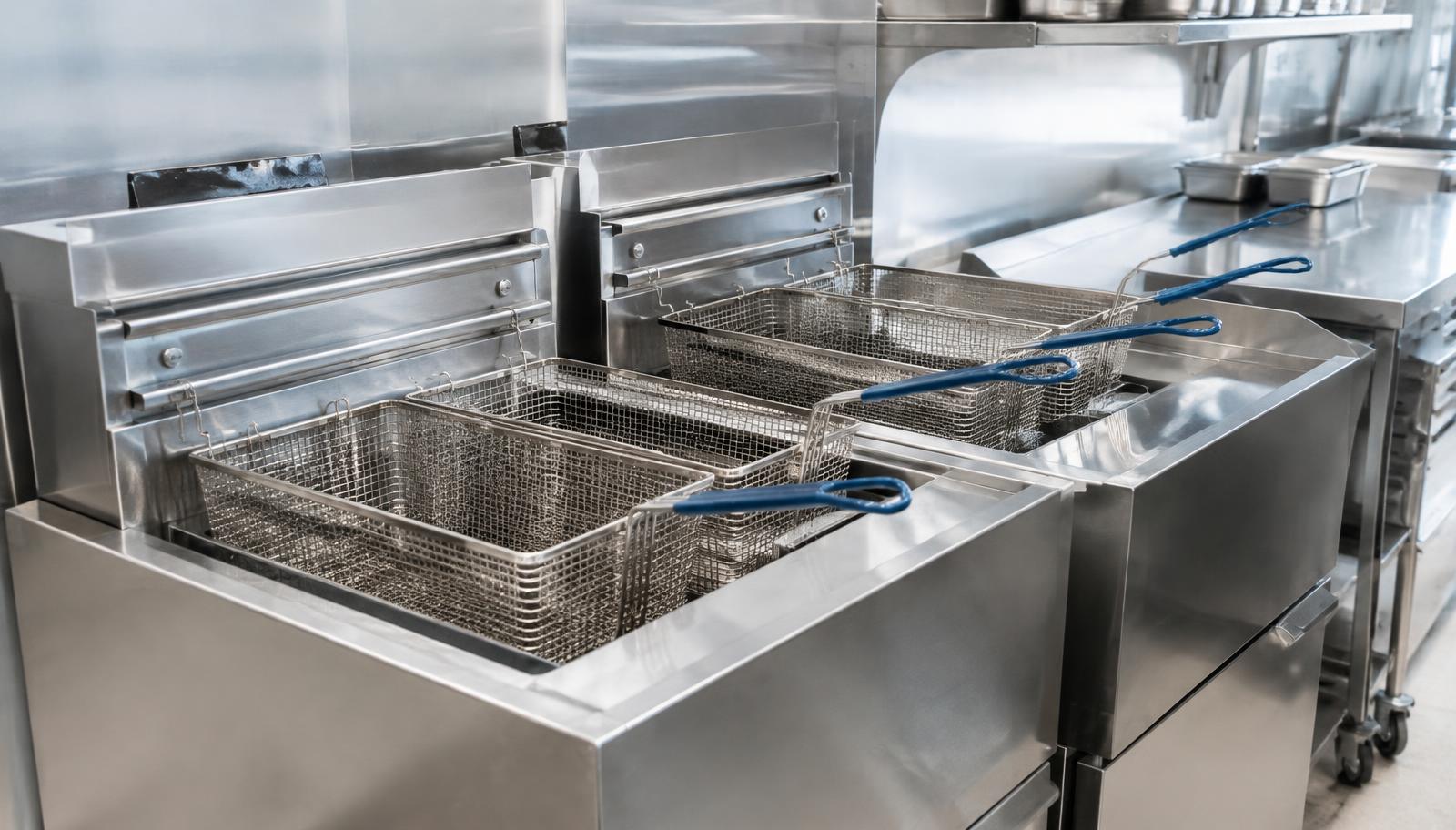
Frying oil is usually around 170 to 190°C, nearly twice the temperature at which water boils. When water hits it, the water sinks below the surface, turns to steam in a fraction of a second and expands rapidly. That steam blasts burning oil up and out of the fryer as a fireball.
That's why fire services are blunt about it. As West Yorkshire Fire and Rescue Service puts it: never use water on a hot oil fire.
The same reaction happens on a smaller scale every day in kitchens, when wet or frozen food goes into hot oil and the fryer spits or foams up. If oil is close to the top of the fryer, that boil-over can reach the burners.
What to do if a fryer catches fire
In a commercial kitchen
- Raise the alarm and get everyone else out of the kitchen.
- Turn off the heat at the fryer controls or the emergency cut-off, but only if you can reach it safely.
- Don't move the fryer or carry burning oil anywhere.
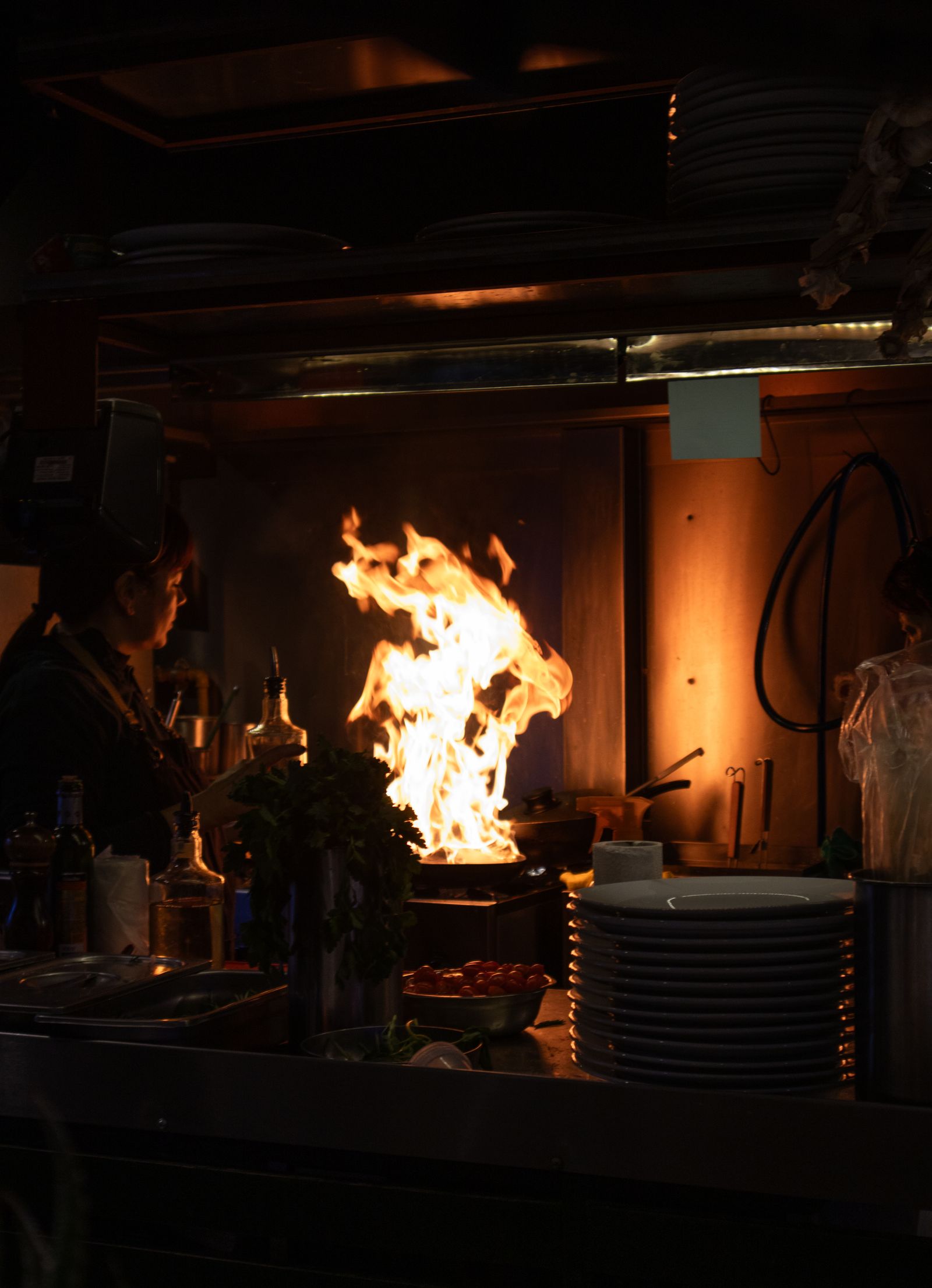
- If the fire is small and you've been trained, use the wet chemical extinguisher. Hold the lance at arm's length, squeeze the lever slowly and apply the spray in slow, circular movements so it falls gently onto the oil. Keep going until it's empty.
- If the fire is spreading, or the extinguisher hasn't worked, get out, close the doors and call 999.
- Afterwards, keep watching the fryer. Oil holds its heat for a long time and can reignite.
- Get the extinguisher recharged or replaced straight away, and record the incident.
A chip pan fire at home
Fire services advise against tackling it yourself:
- Don't throw water on it.
- Don't try to move the pan.
- Turn off the heat if it's safe to do so.
- Get out of the room, close the door, get everyone out of the house and call 999.
- Don't go back in until the fire service says it's safe.
The fire risk most guides miss: your oil
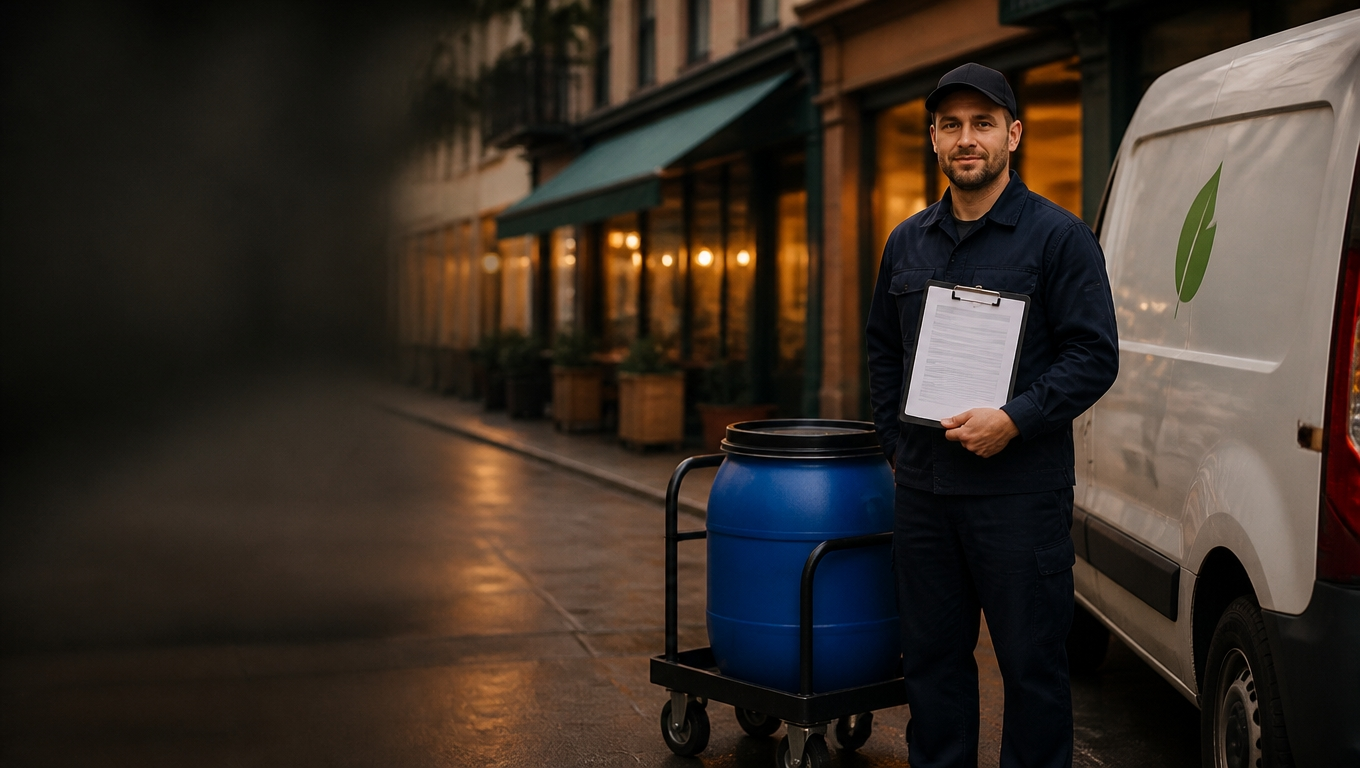
Most fire safety advice stops at the extinguisher. From an oil collector's point of view, the oil itself, before and after it leaves the fryer, is where a lot of avoidable risk sits.
Old oil is a bigger fire risk
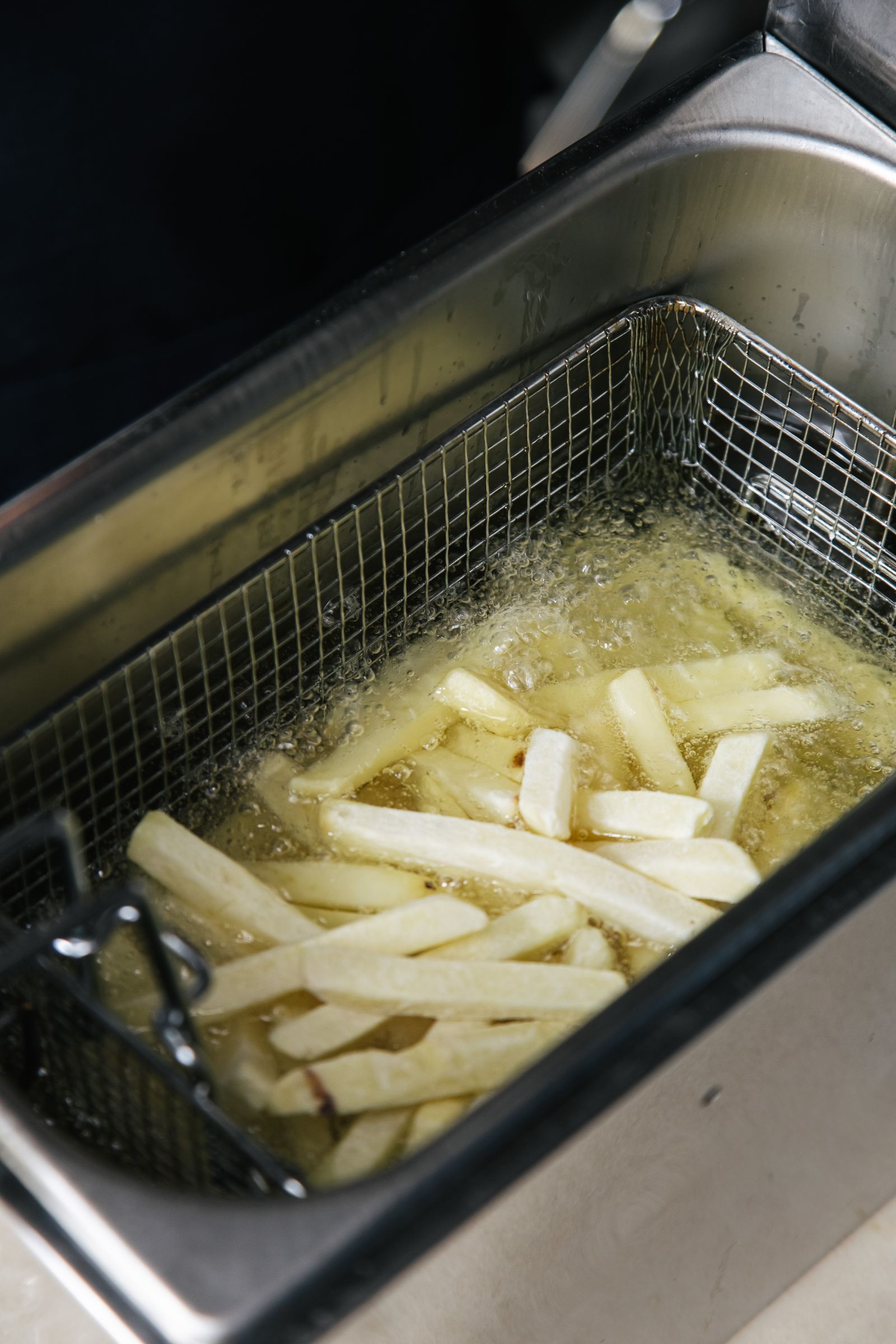
As frying oil breaks down with use, it darkens, smokes and froths more, because the oil is splitting into free fatty acids. Research on oil used by food vendors found free fatty acid levels rose more than tenfold after ten frying batches (Mishra et al., Discover Food, 2023). Smoking, foaming oil is closer to the point where it can catch fire.
The practical rules:
- Filter your oil daily and skim out food debris.
- Change it when it's dark, smoking at normal frying temperature or foaming, not when it's run out.
- Never fill a fryer above the maximum line.
- Make sure your fryer has a working high-limit thermostat that cuts the heat if the oil overheats. Insurer guidance sets this at 230°C.
Let it cool before you decant it
Hot oil and plastic don't mix. Decanting oil that's still hot into a plastic drum risks the drum softening and splitting, burns to staff and oil across the floor. Switch the fryer off and let the oil cool fully before you drain it.
Where you store waste oil matters
Used cooking oil is safe to store when it's cool and sealed, but where you put it counts.
- Keep waste oil containers away from fryers, ovens, hobs and other heat sources.
- Never store drums in corridors, doorways or fire escape routes. Fire services are clear that escape routes must be kept clear at all times.
- Keep lids closed and clean up spills straight away. Oil on the floor near a fryer is a slip risk, and a slip while carrying hot oil is how serious burns happen.
- Book collections before containers are full, so oil doesn't end up in buckets and saucepans around the kitchen.
See our guide on how to store used cooking oil for more detail.
Oily tea towels can set themselves alight
This catches out pubs and restaurants every year. Tea towels, cloths and chef whites that still carry cooking oil after washing can heat up on their own, especially when they're piled up warm from the tumble dryer. In 2024, Staffordshire Fire and Rescue Service warned businesses after cloths caught fire at a Stoke-on-Trent restaurant. A pub near Kettering had a basket of freshly dried tea towels smoulder for three hours (Northamptonshire Fire and Rescue Service).
To prevent it:
- Wash kitchen cloths at a high temperature with a detergent that removes oil.
- Always let the tumble dryer finish its cool-down cycle.
- Air laundry before folding, and never leave warm laundry in piles or bags.
- Don't leave laundry in the dryer overnight.
Grease in your extraction: the hidden fire risk
Every time you fry, a fine mist of oil goes up into the canopy, filters and ductwork, and some of it stays there. Over months it builds into a layer of grease that can catch fire and carry flames through the building. Bedfordshire Fire and Rescue Service says 70% of fires in commercial kitchens start in ventilation systems where fat and grease have built up.
The industry standard for cleaning, TR19 Grease from the Building Engineering Services Association, sets minimum frequencies for the ductwork based on how long you cook each day (BESA):
- 12 to 16 hours a day: every 3 months
- 6 to 12 hours a day: every 6 months
- 2 to 6 hours a day: every 12 months
Canopies and filters need cleaning far more often, daily or as the manufacturer recommends. Keep the cleaning certificates. Many insurers now ask for proof of extract cleaning, and a claim can be refused if a fire is traced back to poor maintenance.
Your legal duties as a food business

In England and Wales, fire safety in commercial premises comes under the Regulatory Reform (Fire Safety) Order 2005. The business owner or manager is the "responsible person", and must:
- carry out a fire risk assessment and keep it up to date. If you have 5 or more staff, or a licence, you must record the significant findings
- put suitable firefighting equipment in place, based on that assessment
- have extinguishers and other fire equipment tested and maintained every year by a competent person, and check weekly that they're in place and look in working order
- train staff on what to do in a fire, including how to use the kitchen's extinguisher
- keep escape routes and fire doors clear
- keep cooking equipment and extraction maintained and clean
Fire safety also feeds into your food hygiene rating. Grease build-up, spilt oil and poorly stored waste count against the condition of your premises.
Fryer fire safety checklist
- A wet chemical (Class F) extinguisher within easy reach of the fryers, serviced every year.
- A fire blanket for small pan fires.
- Staff trained to use both, and told never to use water on oil.
- Fryers fitted with a working high-limit thermostat and an easy-to-reach emergency cut-off.
- Oil filtered daily and changed before it smokes or foams.
- Fryers never filled above the maximum line.
- Oil left to cool fully before it's drained or decanted.
- Waste oil stored in sealed containers, away from heat and escape routes.
- Canopies and filters cleaned regularly, and ductwork cleaned to TR19.
- Kitchen cloths washed hot, cooled in the dryer and never piled up warm.
- A written fire risk assessment, reviewed regularly.
Regular oil collections take one item off this list: no overflowing drums or buckets of old oil around the kitchen. Bio UK Fuels supplies sealed containers and collects across England and Wales, free from 60 litres, with a rebate from 100 litres upwards. Arrange a free used cooking oil collection, or read our guide on how to dispose of used cooking oil.
Sources
- Ecclesiastical Insurance, kitchen fire safety (2021): wet chemical Type F extinguisher annually maintained where deep frying; high-limit thermostat cutting heat above 230C
- Fire Protection Online: Class F, wet chemical, saponification, yellow label
- Safelincs: how to use a wet chemical extinguisher
- West Yorkshire Fire and Rescue Service, chip pan fire advice
- Mishra et al., Discover Food 3:7 (2023), free fatty acids rise with repeated frying
- Staffordshire Fire and Rescue Service (Sept 2024), tumble dryer laundry fires
- Northamptonshire Fire and Rescue Service (Aug 2020), tea towels smouldered at pub
- Bedfordshire Fire and Rescue Service, kitchen extract fire hazards, 70% statistic, cleaning frequencies, recording findings
- BESA, TR19 Grease frequencies and insurance
- GOV.UK fire safety risk assessment guide, annual maintenance and weekly checks
- Dorset & Wiltshire Fire and Rescue, restaurants: written fire risk assessment, escape routes
Frequently asked questions
Filed under:Cooking Oil Disposal

Written by
Martin SimpkinsCo-founder of Bio UK Fuels in 2008. With 18 years in the industry, Martin helps commercial kitchens recycle used cooking oil legally and turn it into biodiesel.
More articles by Martin →Need your used cooking oil collected?
Free collection across England & Wales, and we pay you for 100 litres or more. Full Duty of Care paperwork every time.